Business process re-engineering & automation

From chaos
to clarity.

We re-engineer the processes that run your business — then automate them on a no-code workflow engine you can actually audit.

Working inside enterprise workflow platforms since Kintana, 2002.

The fragmentation tax

One process. Eleven hand-offs.

Every hand-off between systems is a place where data is re-keyed, reconciled, or dropped. Press the switch.

A single approval, as it actually runs

Systems stay. The process layer changes.

Not yet traversed Already traversed Current step
SubmittedRequester
ScreeningBusiness Analyst
AssessmentSpecialist
DecisionApprover

Two steps, one definition. The panel is configured once and placed wherever it's needed — change it in one place and both stages change.

Approval — three sub-processes, running at the same time
Finance
Budget checkController
ClearedFinance
Security
Risk reviewInfoSec
ClearedInfoSec
Legal
Contract reviewCounsel
ClearedCounsel

All three run concurrently. The parent step advances only when every lane clears — and any one of them can send it back.

Click either Panel Review — three reviewers open and run concurrently inside the parent step.

Rejected at Review? It returns to Submitted with the reason attached — and the loop is part of the process, not an exception someone handles by email.

See real ones — workflows running on the engine today

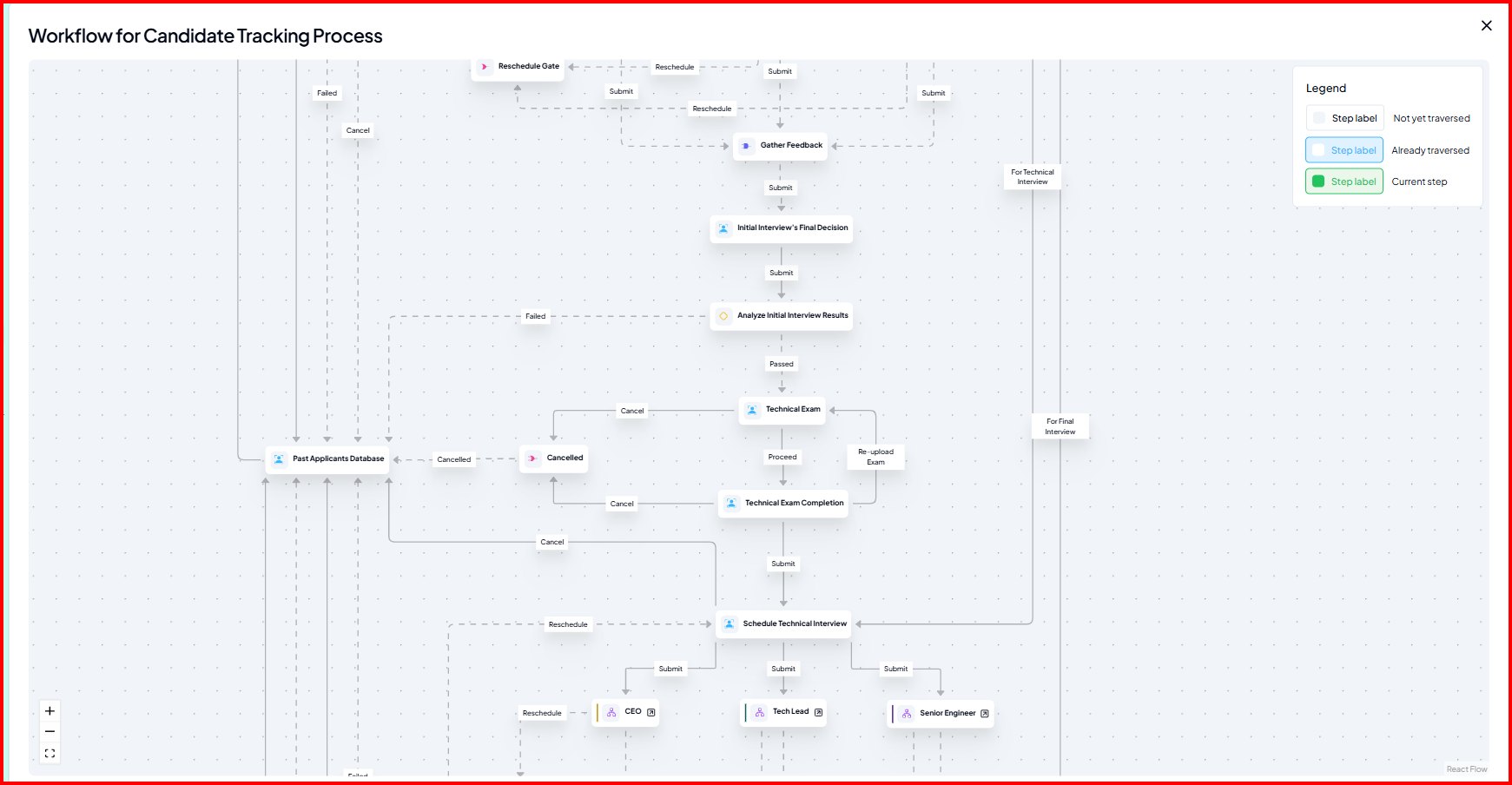
The diagram above is a teaching example. These are actual workflows in the platform, rendered live: grey is not yet traversed, blue is already traversed, green is where the item sits right now.
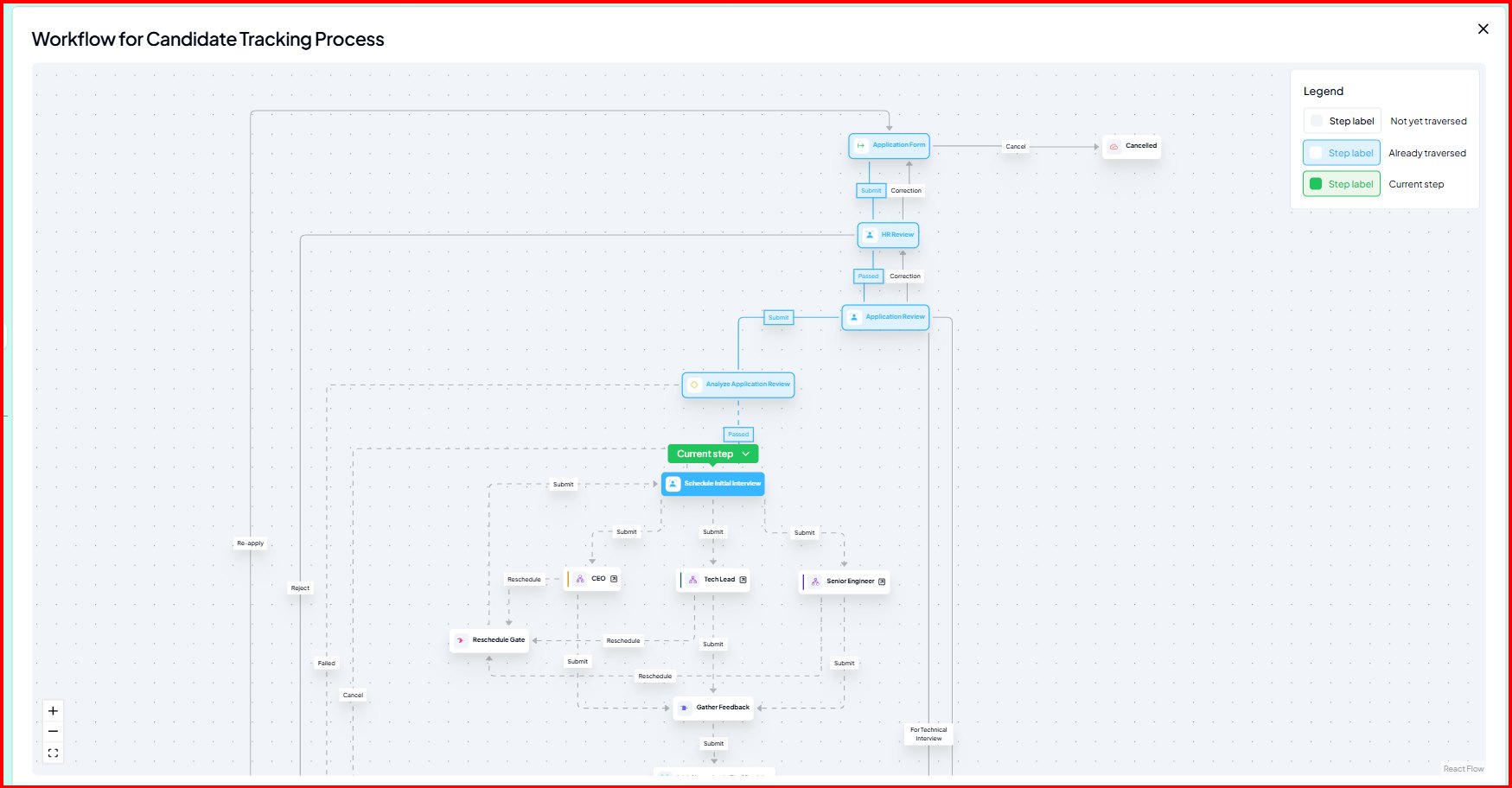
Candidate tracking — intake and the first interview panel
Intake, and the first panel. Application Form → HR Review → Application Review → Analyze → Schedule Initial Interview, then three interviewers — CEO, Tech Lead, Senior Engineer — fan out in parallel and converge on Gather Feedback. Every review stage has a Correction path back.
Candidate tracking — technical stage, same panel reused
The same panel, reused. After the technical exam, Schedule Technical Interview fans out to the identical three-reviewer sub-process. Defined once, instantiated at a second point in the parent flow.
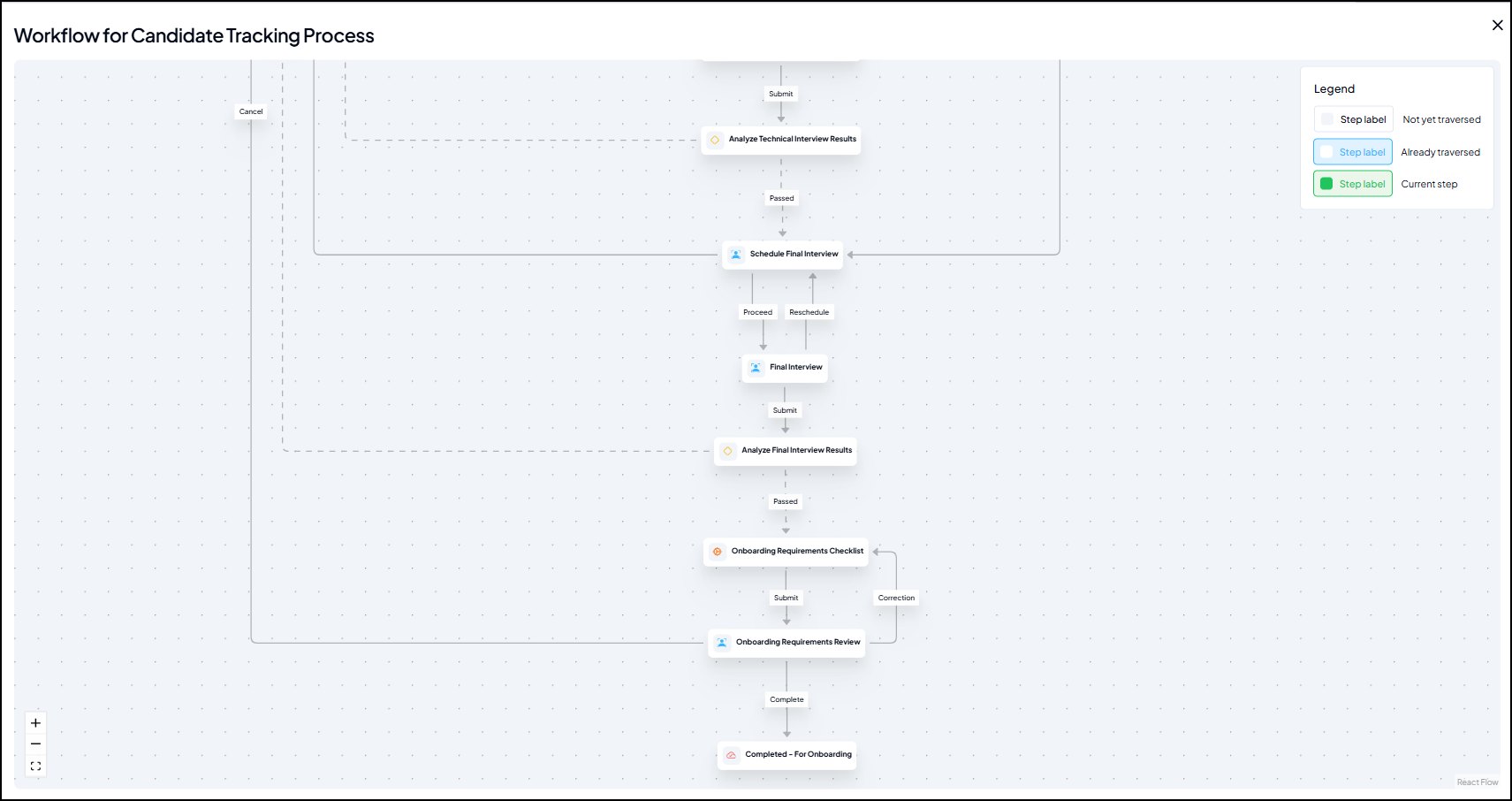
Candidate tracking — final interview through onboarding
Through to onboarding. Final Interview → Analyze → Onboarding Requirements Checklist → Review → Completed, with a Correction loop on the checklist and Cancel reachable from nearly every state.
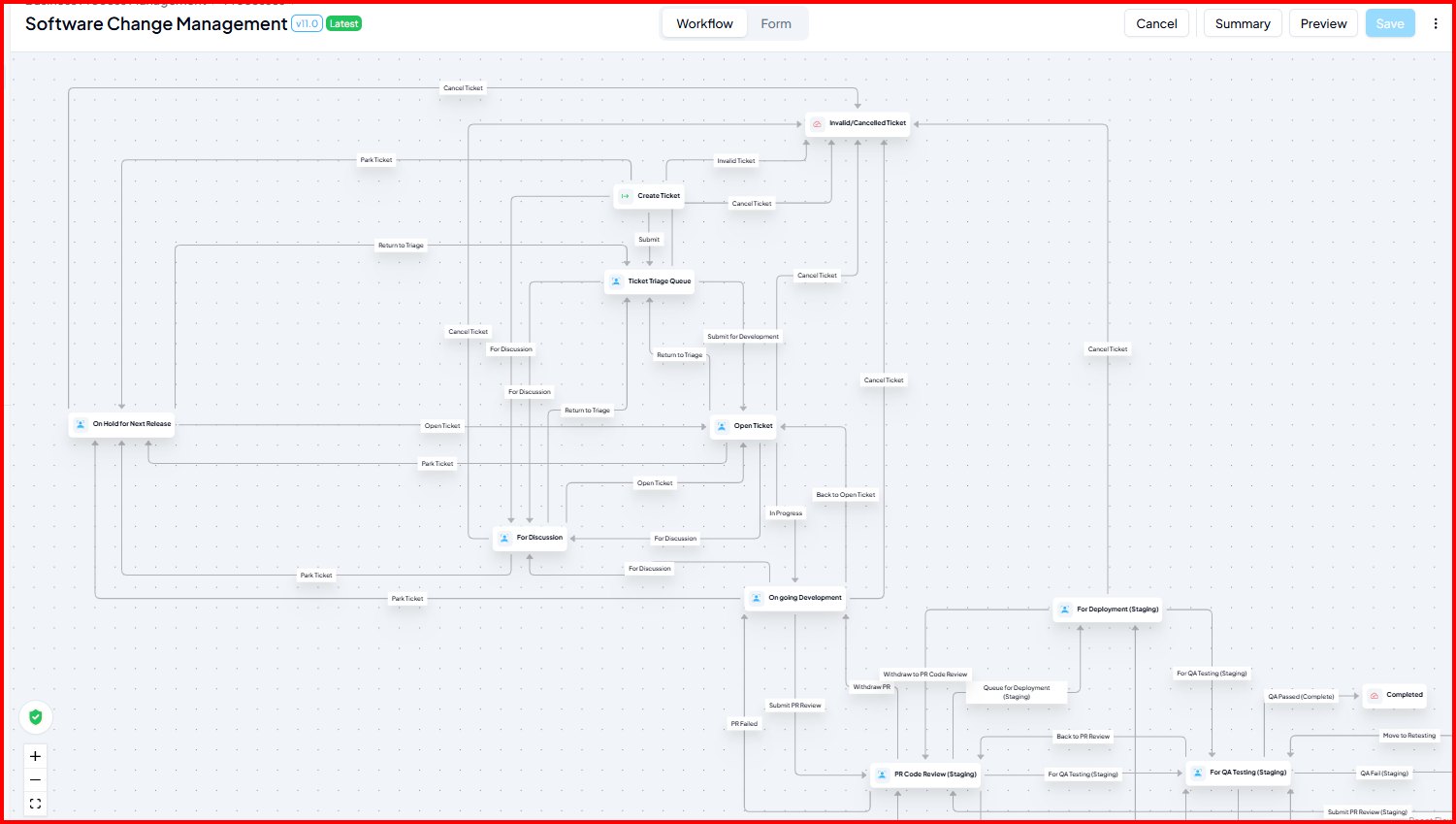
Software Change Management — ticket intake and triage
Software Change Management — our own development process. Create Ticket → Ticket Triage Queue → Open Ticket → Ongoing Development, with Park Ticket, Return to Triage, For Discussion and Cancel Ticket reachable from nearly every state. Note the version marker: this process is at v11.0.
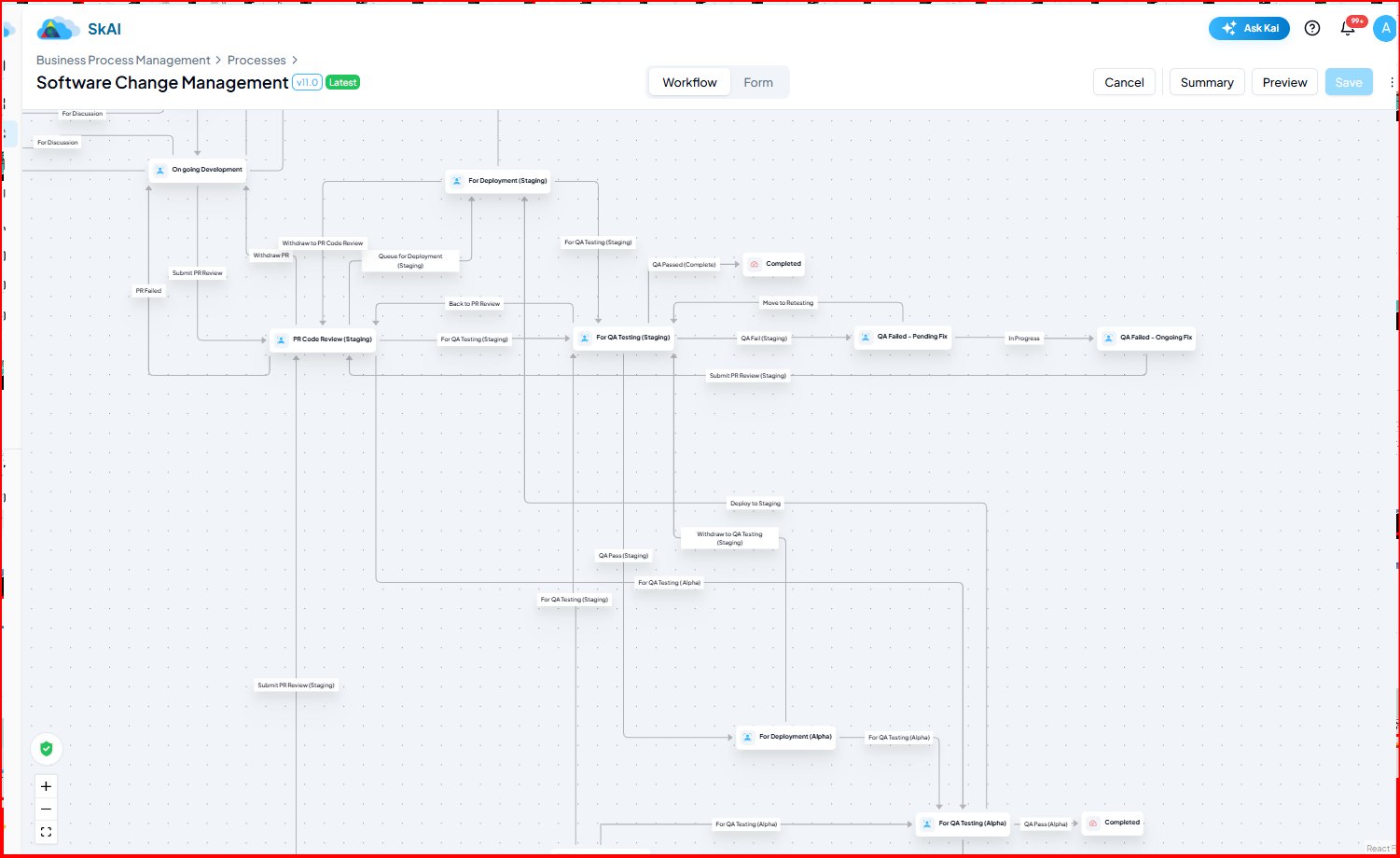
Software Change Management — staging track
The staging track. For Deployment → PR Code Review → For QA Testing, then either QA Passed (Complete) or a failure loop through QA Failed – Pending Fix → Ongoing Fix and back for retest. Withdraw PR reverses a step that shouldn't have happened.
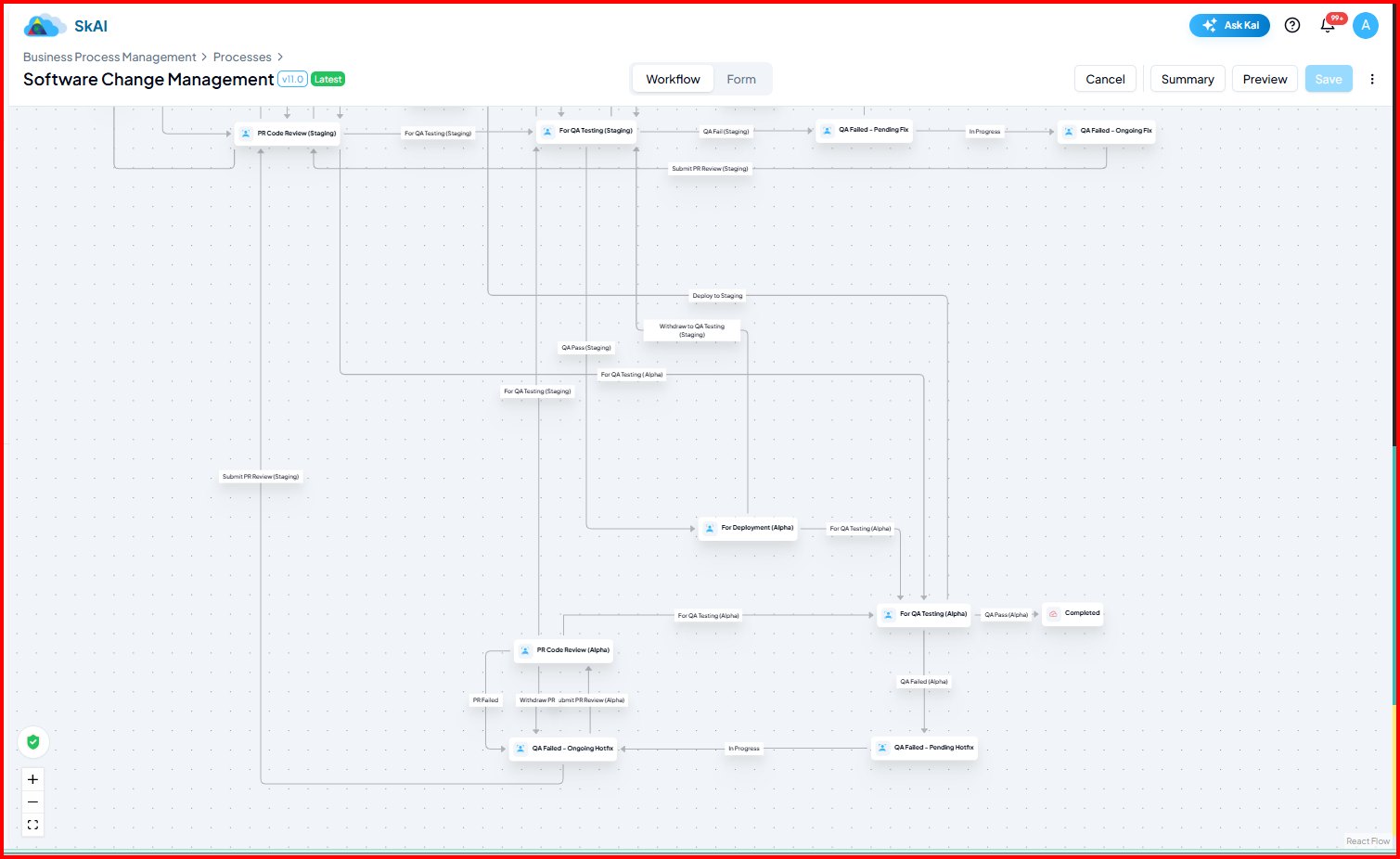
Software Change Management — alpha track
The alpha track, running in parallel. Same shape, different semantics — staging failures become a Fix, alpha failures become a Hotfix. One process definition, two environments, each with its own terminal Completed.

Nodes are statuses. The labels on the connectors are the named transitions that move an item between them — Submit, Passed, Correction, Reschedule, Re-apply. Nothing is compiled; the process is the configuration.

Two details worth noticing, because they are the parts that are hard to build: a single Reschedule Gate serves all three reviewers rather than each carrying its own logic, and candidates who don't proceed land in a Past Applicants Database with a Re-apply route back in. The process has a memory.

And processes are versioned — the change-management flow above is at v11.0. It has been revised eleven times without a release, a migration, or a developer.

11hand-offs between systems
6places data is re-keyed
0people who can see the whole
Where we are honest Those figures illustrate a pattern we have seen repeatedly; they are not a measurement of your organisation. We have not found a defensible published figure for the cost of fragmentation — every version we traced led back to marketing material. So we don't quote one.
How we know

Twenty-two years inside other people's platforms.

We didn't arrive at this from a whiteboard. We arrived at it by implementing the same class of system, for two decades, and watching the same thing go wrong.

2002
Kintana

Before Mercury bought it. Before HP bought Mercury. Four certificates, and a first look at what a workflow engine could do.

2004
The practice begins

Left Mercury Interactive to work directly with the organisations trying to make these platforms fit how they actually operate.

2006 – 2015
The pattern repeats

Newspapers, transit, credit unions, publishers, manufacturers. Different industries, identical failure: the platform was never the hard part.

The conclusion
It was structural

Licences weren't the cost. Fragmentation was. And every tool assumed a process it had decided in advance — so the work bent to the software.

2026
So we built the alternative

A no-code, status-based workflow engine, designed for the people who own the process rather than the people who write code.

The receipts — who said what, and when

"It quickly became evident that Abraham's knowledge of the platform far out-shined HP's own technical consultants." Steve Bagley — Director, Portfolio Management & Delivery CoE, Scholastic Inc., 2013

"Abraham was the key enabler in our transformation from a manual driven process to a unified Portfolio Management system." — John D. Ramos, Operations Manager, Education Technology, Scholastic Inc., 2013

"Quiksilvr has taken a verbal, paper based at best process and made it efficient and manageable. We average 250+ active deliverables on a daily basis." — Debbie Tolman, Marketing Operations Manager, The Atlanta Journal-Constitution, 2008

"After working together for almost 10 years in different organizations, I still strongly recommend him over any other candidates." — Derek Giedd, Sr. Applications Engineer, Cox Communications, 2015

Twelve signed letters of recommendation, 2002–2015. All name the principal personally. We quote them as written.

The engine

Software that conforms to you — not the other way round.

A pre-built application encodes somebody else's idea of how your work should happen. You either bend your organisation to it, or pay to customise it — then pay again at every upgrade.

What "status-based" means, in plain terms

Most automation is written as code: a developer describes, step by step, what the computer should do. Change the process and you change the code.

A status-based engine works differently. You describe the states a thing can be in — drafted, submitted, approved, returned, closed — and the rules for moving between them: who may move it, what must be true first, what happens on the way.

Nothing is compiled. The process is the configuration. Which is why the person who knows why step four exists can change step four — without a developer, a ticket, or a release.

Isn't "one platform" exactly what ERP promised?

It is, and that promise has a graveyard. Birmingham City Council budgeted £19m for an Oracle implementation; the statutory auditor put the eventual cost at roughly £109m, and named governance and programme management — not the product — as the cause.

The distinction matters. An all-in-one application replaces your systems of record. That is the thing that fails. An all-in-one process layer leaves your systems where they are and unifies the work that runs across them.

We are not asking you to rip anything out. We are asking who owns the process that currently lives in the gaps between your systems.

Why an engine matters more once you add AI

71% of organisations are using AI agents. 11% have one in production. The gap is not model quality — it is that long chains of autonomous steps degrade, and nobody can prove to an auditor what happened.

35.8%chance the whole process completes unaided

Arithmetic, not a measurement — n independent steps at rate p. Real agent chains fare worse, because errors correlate. Put the model inside an engine that owns state, sequence and retries, and the engine's determinism carries the process instead.

Sources: Camunda / Coleman Parkes 2026 (n=1,150, commissioned by Camunda) · Forrester, The State of Agentic AI 2026 · Anthropic, Building Effective Agents.

A robotic process automation company I worked for in Silicon Valley — a firm whose entire business was automating other people's work — ran its own delivery on Salesforce and Jira. Two enterprise licences, two administrators, two sources of truth, and a seam down the middle where the hand-offs lived. We run the equivalent end to end on one engine. That is the whole argument, and I learned it by watching the alternative from the inside.
Where we are honest The engine is at alpha. It runs, we build on it, and we will show you what it does not do yet. The re-engineering work stands entirely on its own and does not depend on it.

The platform this became

Twenty-two years of implementations turned into a product. The engine is built and owned by SkAI Technologies, Inc., and runs on its SkAIform platform. Digital Business Process is a separate company and SkAI's independent implementation partner.

Visit SkAIform →
Proof

Not a theory. A track record.

250+deliverables processed dailyAJC workflow system
250+department personnel supportedScholastic Inc.
4 yearscontinuous portfolio engagementScholastic, 2009–2013
2002working with this class of platform sinceKintana
Navy Federal Credit Union · via The Goal Cox Communications · via Crystal Equation Scholastic Inc. · via Marshwinds

Principal's practice also spans The Atlanta Journal-Constitution, MARTA, General Motors, the University of Minnesota and GMAC-RFC.

Where we are honest We name the firm we contracted through on every engagement. Work done as an employee is listed as the principal's experience, not as a client of this firm. The distinction matters in procurement, and most consultancies blur it.
Who we are

A principal-led practice.

Digital Business Process is led by Abraham Delgado, who has worked with enterprise workflow platforms since Kintana in 2002 and founded the practice in 2004 after leaving Mercury Interactive.

We say principal-led rather than describing a team, because that is what is true. When you engage us, you work with the person whose name is on the recommendation letters — not a bench of juniors billed at his rate. Specialists are brought in under contract when an engagement needs them.

He is also the founder of SkAI Technologies, Inc., where the workflow engine described above was built. The two are separate companies; Digital Business Process is SkAI's implementation partner.

Abraham Delgado on LinkedIn →

Talk to us

Start with an hour.

I have a process that frustrates us

Bring it. One hour, no charge — we map what actually happens, where the waste sits, and what should be eliminated before anything gets automated.

Book the hour

I want to see the engine

A working demonstration of no-code, end-to-end automation — including an honest account of what it does not do yet.

Request a demo

No deck, no pricing conversation. If the answer is that you don't need software, we'll say so — it's usually the most valuable hour we spend.